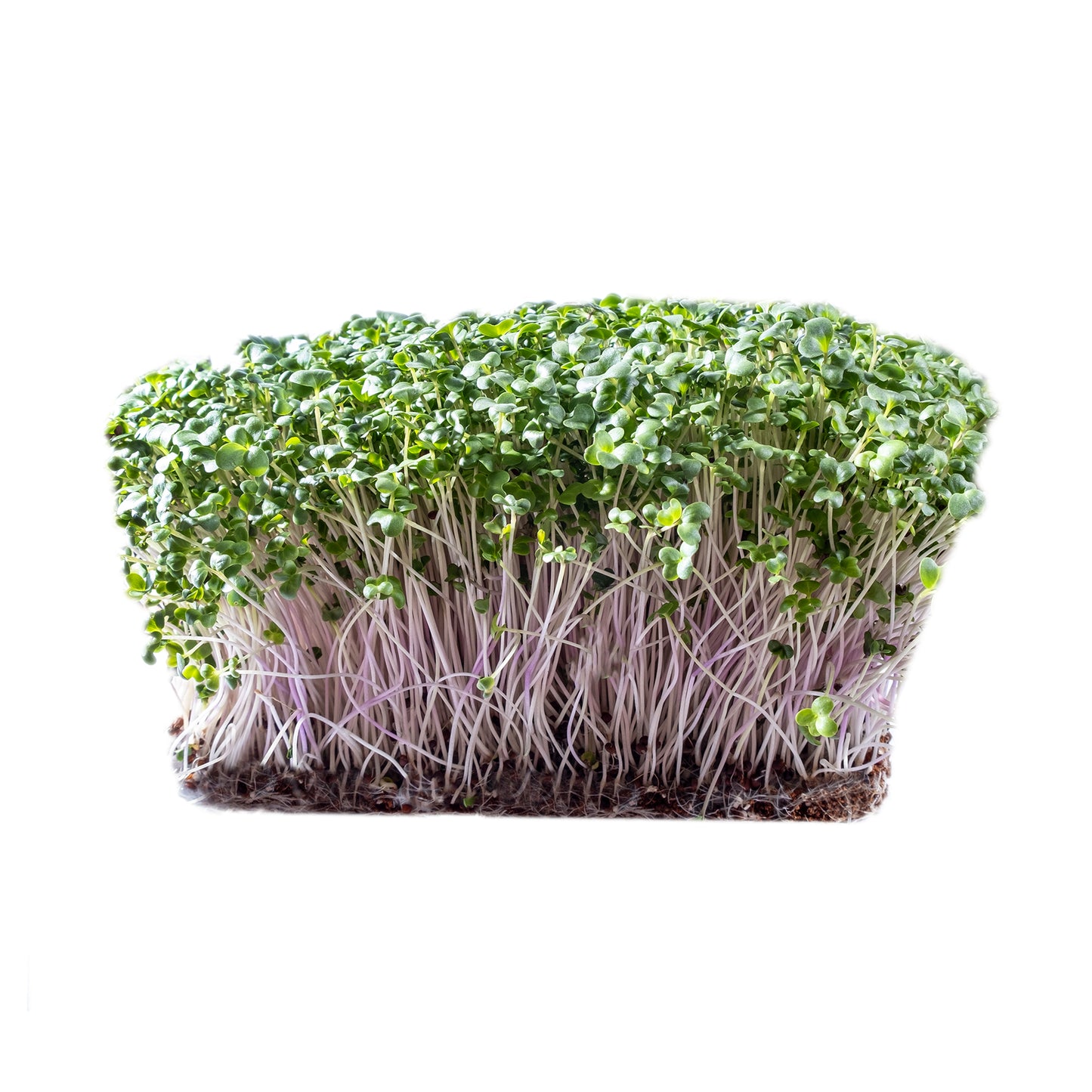
Broccoli Purple Haze Microgreens Seeds
Broccoli Purple Haze Microgreens Seeds
Couldn't load pickup availability
The King of Superfood Microgreens — With a Purple Twist
If there is one microgreen that has earned its reputation through hard science, it's broccoli. Brassica oleracea var. italica is the most studied microgreen in the world, and for good reason: its young shoots are extraordinarily rich in glucoraphanin, the precursor compound your body converts into sulforaphane — one of the most researched plant compounds in nutritional science.
Purple Haze takes that nutritional foundation and adds something beautiful. Alongside the classic green cotyledons, this variety develops delicate violet-tinged stems — a colour that comes from anthocyanins, the same antioxidant pigment family that makes blueberries and red cabbage so nutritionally valuable. The result is a microgreen that delivers on both plate appeal and substance.
Grown from premium Italian-origin seeds, Purple Haze offers exceptional germination, fast reliable growth and a mild, fresh broccoli flavour with a gentle earthy edge — far softer than mature broccoli and genuinely enjoyable raw. Ready to harvest in 8–12 days and forgiving enough for complete beginners, it's the microgreen we'd recommend to anyone starting out.
📋 Product Specifications
| Botanical Name | Brassica oleracea var. italica |
| Common Names | Broccoli Purple Haze, purple broccoli microgreens |
| Plant Family | Brassicaceae (Cruciferous family) |
| Seed Origin | Italy 🇮🇹 |
| Seed Type | Untreated, premium grade |
| Germination Rate | ≥ 98% |
| Days to Germination | 1–3 days |
| Harvest Window | 8–12 days (cotyledon to first true leaf) |
| Seeding Rate | ~4 g per standard tray (10×20 cm) |
| Growing Method | Coconut coir / Linen mat / Rockwool |
| Soaking | Not required — sow dry |
| Blackout Period | 2–4 days |
| Key Compound | Glucoraphanin → sulforaphane, plus anthocyanins |
| Difficulty Level | Easy — ideal for beginners |
| Available Sizes | 100 g / 250 g / 500 g |
Sulforaphane figure refers to the landmark Johns Hopkins finding on young broccoli shoots (Fahey et al., 1997). Levels vary with variety, growing conditions and harvest stage.
How to Grow Broccoli Purple Haze Microgreens
Broccoli is the microgreen most growers start with — and Purple Haze is no exception. It germinates within a day or two, grows fast and evenly, and needs no soaking or fertiliser. Follow these steps for a dense, healthy tray every time.
Step-by-Step Growing Guide
No Soaking Needed
Broccoli seeds are small and germinate readily — pre-soaking is unnecessary and can cause them to clump. Sow them dry directly onto your prepared growing medium.
Prepare Your Medium
Coconut coir, a linen mat or rockwool all work excellently. Pre-moisten so the medium is damp but not waterlogged, and make sure your tray drains freely.
Sow Evenly & Densely
Scatter seeds uniformly across the surface — approx. 4 g per standard 10×20 tray. Broccoli tolerates dense sowing well. Don't cover with substrate; simply mist the seeds in.
Blackout Period
Cover with a second tray or blackout dome for 2–4 days at 18–22 °C. Mist once daily if the surface dries. This dark phase drives the stems upward, giving you longer, cleaner cuts.
Expose to Light
Once the seedlings lift the cover, move them under grow lights or to a bright spot (6–10 h/day). The leaves green up within hours and the anthocyanins develop, bringing out the signature violet haze in the stems.
Water from the Bottom
Switch to bottom watering — sit the tray in a shallow dish of water for a few minutes. Dry leaves are the single best defence against mould, the main risk with brassica microgreens.
Keep Air Moving
Run a gentle fan for a couple of hours a day. Good airflow keeps the canopy dry, strengthens the stems and virtually eliminates damping-off. Avoid overwatering at all stages.
Harvest at 8–12 Days
Harvest when cotyledons are fully open and the first true leaves are just appearing — usually 8–12 days. Cut just above the medium with clean scissors and use fresh for the best flavour and nutrition.
The Most Researched Microgreen in the World
No microgreen has attracted more scientific attention than broccoli. The reason is glucoraphanin — a glucosinolate that converts to sulforaphane when the plant cells are damaged, which happens naturally as you chew. A landmark 1997 study at Johns Hopkins University found that very young broccoli shoots can carry 20–50 times the sulforaphane potential of a mature broccoli head, gram for gram. Purple Haze adds anthocyanin antioxidants on top of that foundation.
Sulforaphane Powerhouse
Broccoli microgreens are the richest common dietary source of glucoraphanin, the precursor to sulforaphane — the compound behind decades of research into cruciferous vegetables and cellular health.
Cellular Detox Support
Sulforaphane is one of the most potent known activators of the Nrf2 pathway — the body's own antioxidant and detoxification response system, which supports natural cellular defence.
Anthocyanin Antioxidants
The violet tones in Purple Haze come from anthocyanins — the same pigment family found in blueberries and red cabbage, widely studied for their antioxidant and anti-inflammatory activity.
Vitamins A, C & K
Broccoli microgreens are a strong source of vitamin C for immune support, vitamin A (beta-carotene) for vision and skin, and vitamin K for bone health and normal blood clotting.
Anti-Inflammatory Profile
Research on broccoli sprouts and microgreens has explored antioxidant, anti-inflammatory and antimicrobial activity — part of why cruciferous vegetables are so consistently recommended in dietary guidelines.
Fibre & Digestion
Like all brassica microgreens, they contribute dietary fibre and plant compounds that support gut health — in a raw, concentrated, low-calorie form that's easy to add to any meal.
🧬 Full Nutrient Profile
| Vitamins | C, A (beta-carotene), K, E, B-complex (folate, niacin, thiamin) |
| Minerals | Calcium (Ca), Iron (Fe), Magnesium (Mg), Potassium (K), Phosphorus (P), Selenium (Se), Sulfur (S) |
| Signature Phytochemicals | Glucoraphanin → sulforaphane, glucosinolates, isothiocyanates, indole-3-carbinol |
| Antioxidants | Anthocyanins, lutein, zeaxanthin, polyphenols, flavonoids |
| Amino Acids | Present in the early growth stage, supporting the seedling's rapid development |
| Macronutrients | High fibre, low fat, low calorie, plant protein |
Mild, Fresh & Endlessly Versatile
Broccoli Purple Haze has one of the most approachable flavours in the microgreen world — mild, fresh and lightly earthy, with none of the sulphurous bite of mature broccoli. That gentleness is its superpower: it slips into almost any dish without dominating, while the violet-tinged stems add a quiet visual lift. Always serve raw or added at the very end.
🥤 Smoothies & Juices
- The number one use — mild flavour disappears into any smoothie
- Blend with banana, apple and spinach for a daily sulforaphane hit
- Add to cold-pressed green juices with cucumber and lemon
- Stir into yogurt bowls with berries for a double antioxidant boost
🥗 Salads & Bowls
- A fresh, crunchy base or topping for any green salad
- Excellent in grain bowls with quinoa, avocado and tahini
- Pairs beautifully with citrus, sesame and light vinaigrettes
- Mix with other microgreens for a nutrient-dense house blend
🥪 Sandwiches & Wraps
- Layer generously — mild enough to use as a lettuce replacement
- Superb with hummus, roasted vegetables and feta in a wrap
- A fresh, crunchy upgrade for burgers, bagels and toasties
- Great in fresh spring rolls with prawns, tofu or crunchy veg
🥚 Eggs & Breakfast
- Scatter over omelettes and scrambled eggs off the heat
- The classic partner for avocado toast — colour and nutrition
- Top savoury porridge and breakfast bowls
- Fold through a frittata just before serving
🍲 Soups & Hot Dishes
- Scatter over soups at the table — never cooked in
- A fresh finish for ramen and noodle bowls off the heat
- Sprinkle over pizza and pasta once plated
- Stir through risotto in the final seconds off the hob
🍽️ Plating & Garnish
- The violet-tinged stems give a subtle, elegant plating accent
- Works on canapés, tartare and cured fish plates
- A restaurant-grade finish for creamy soups and purées
- Perfect scattered over grain bowls for a professional look
Frequently Asked Questions
Share