Nasturtium Microgreens Seeds
Nasturtium Microgreens Seeds
Couldn't load pickup availability
Peppery Shield Leaves From Your Windowsill
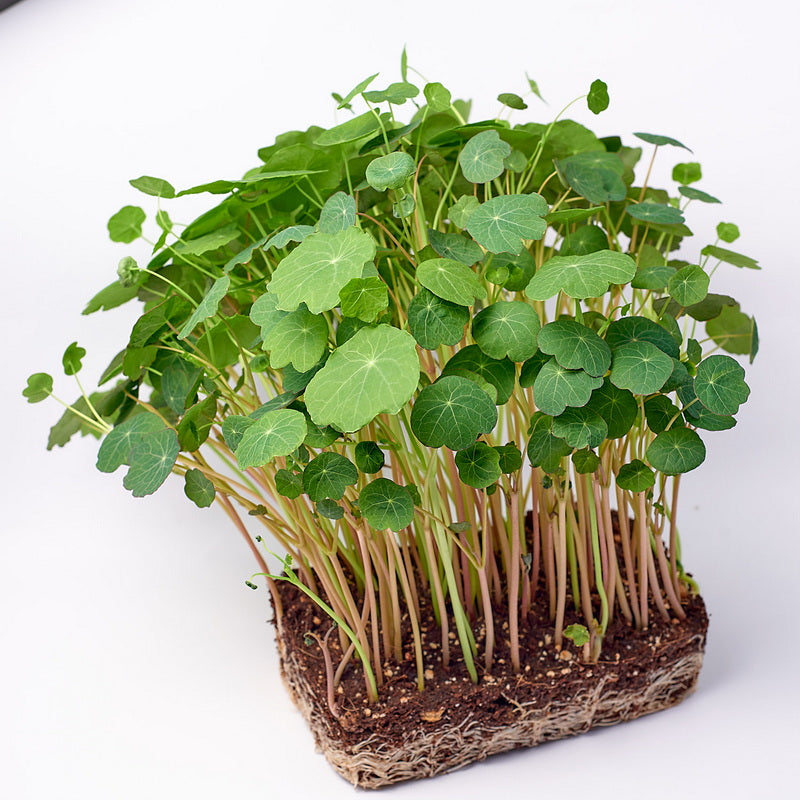
Nasturtium is best known as a cheerful garden flower, but every part of it is edible — and its young leaves carry the most flavour. Linnaeus named the genus Tropaeolum, from the Greek word for trophy: the round leaves reminded him of shields, the flowers of helmets. As microgreens they keep that unmistakable shape — a smooth, round leaf on a slender stem, with the stalk attached right in the middle.
The flavour explains the common name. Nasturtium is the Latin name for watercress, from nasus tortus — “twisted nose” — and the plant earned it with a peppery bite, a light tang and a hint of horseradish. It is only a distant relative of cress, but both belong to the same botanical order and both make pungent mustard oils, which is why they taste so alike.
Growing it is straightforward: no soaking, 20 g of dry seed per 11×18 cm container and one golden rule — cover the seeds. A thin layer of coco coir on top, or a firm press into a soft mat, gives even germination. In 8–10 days you can cut tall, tender greens, with roughly three grams of harvest from every gram of seed.
📋 Product Specifications
| Botanical name | Tropaeolum majus |
| Common names | Nasturtium, garden nasturtium, Indian cress |
| Plant family | Tropaeolaceae |
| Soaking | Not required |
| Growing medium | Coco coir, soil, cotton wool or a soft grow mat |
| Seeding rate | 20 g dry seed per 11×18 cm container |
| Covering | Yes — a thin layer of coco coir, or press the seeds firmly into the mat |
| Weighting | Yes — 0.5–1 kg on a stack of containers |
| Germination time | 4–5 days at 20–22 °C |
| Growth after germination | 4–5 days |
| Total time to harvest | 8–10 days |
| Harvest height | 10–15 cm |
| Yield (dry seed : cut greens) | ≈ 1 : 3 |
| Storage | Up to 5 days in the fridge |
How to Grow Nasturtium Microgreens
Nasturtium is a fast and generous crop once you know its two needs: seeds covered while they germinate and moisture kept in balance — damp, never soggy. After that, give it light: it is a sun lover, and a bright windowsill is all it asks.
Step-by-Step Growing Guide
Prepare the substrate
Fill an 11×18 cm container (a berry punnet is ideal) with coco coir or soil, or line it with a soft grow mat. Moisten it evenly — it should feel like a wrung-out sponge.
Sow dry, in one layer
Spread 20 g of dry seed over the surface in a single, close layer. The seeds are large, so you can place them by hand where the cover is thin.
Cover the seeds
This is the key step. Sprinkle a thin layer of moist coco coir over the seeds — or, on a mat, press every seed firmly into it. No seed should lie bare on the surface.
Stack and weigh down
Stack the containers, cover the top one with an empty box or lid and set a 0.5–1 kg weight on it. The pressure keeps seeds and substrate in close contact.
Warm and dark, up to 5 days
Keep the stack in a warm, dark place at 20–22 °C. Keep the moisture balanced — don’t overwater — and air the stack every day to keep the air fresh.
Move into the light
When the shoots lift the weight, remove it, unstack and move the containers to a warm, bright spot. Nasturtium loves sunshine; a windowsill is enough.
Water lightly with a spray bottle
Mist moderately, just enough to keep the substrate damp. The leaves are water-repellent, so aim for the substrate rather than the foliage.
Harvest at 10–15 cm
After 4–5 days in the light, cut the stems just above the substrate with sharp scissors. Store the greens dry in a closed box in the fridge for up to 5 days.
What Gives Nasturtium Its Bite
Nasturtium leaves contain glucotropaeolin, a glucosinolate. When the leaf is chewed or cut, it is converted into benzyl isothiocyanate — a mustard oil and the source of the peppery heat. The plant is also traditionally valued for its vitamin C. Grown as a microgreen, it goes from tray to plate in minutes, at the peak of its freshness.
Cress-Like Heat
The peppery taste comes from mustard oils — the same group of compounds that gives cress, radish and mustard their bite.
A Well-Studied Compound
Benzyl isothiocyanate, formed from glucotropaeolin, is the plant’s best-known compound and a subject of laboratory research.
Valued for Vitamin C
Nasturtium leaves have long been appreciated for their vitamin C. Microgreens are eaten raw and freshly cut, so nothing is lost to cooking.
Flavour Without Extra Salt
A handful of peppery greens makes eggs, potatoes and sandwiches taste fuller, so you can go easier on the salt.
Leaves That Repel Water
Water rolls off nasturtium leaves in round beads — a natural water-repellent surface that keeps the leaves clean and glossy on the plate.
A Fully Edible Plant
On the grown plant, leaves, flowers and buds are all eaten, and the green seeds are pickled as “poor man’s capers”. Microgreens give you the leaf in its youngest form.
🧬 What’s Inside the Leaf
| Glucosinolate | Glucotropaeolin |
| Mustard oil (formed when the leaf is cut) | Benzyl isothiocyanate — the source of the peppery taste |
| Vitamins | Vitamin C |
| Plant family | Tropaeolaceae — in the same order (Brassicales) as cress, radish and mustard |
How to Use Nasturtium Microgreens
Reach for nasturtium microgreens wherever you would use cress, rocket or a touch of horseradish. They are tall and tender, so they work as a garnish and as a salad green in their own right.
🥩 Meat
- Roast beef sandwiches — instead of horseradish
- Steak tartare and beef carpaccio
- Burgers and pulled pork
🐟 Fish
- Smoked salmon and smoked mackerel
- Fish cakes and fish pie
- Prawn cocktail
🥚 Eggs & Cheese
- Egg mayonnaise sandwiches
- Omelettes, scattered on after cooking
- Goat’s cheese and cream cheese
🥗 Salads
- With rocket and pea shoots
- Potato salad
- Tomato and cucumber salads
🍲 Soups
- Potato and leek soup, as a topping
- Tomato soup
- Noodle broths with a peppery finish
🫙 Sauces & Smoothies
- Pesto — half basil, half nasturtium
- Herb mayonnaise for chips and fish
- Green smoothies with apple and cucumber
Frequently Asked Questions
Share