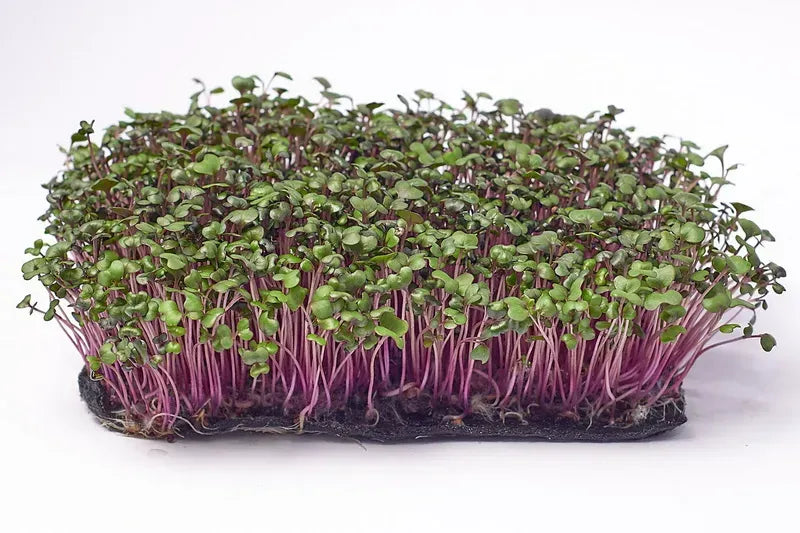
Red Cabbage Microgreens Seeds
Red Cabbage Microgreens Seeds
Couldn't load pickup availability
The Superfood Microgreen Science Can't Stop Talking About
Red Cabbage microgreens — botanically Brassica oleracea — are the young, tender shoots of the red cabbage plant, harvested just as the first leaves unfurl. They're instantly recognisable by their vivid pink-to-violet stems topped with deep green, heart-shaped cotyledons — a colour palette that makes them one of the most beautiful garnishes in any kitchen.
But the real story is what's inside. A landmark 2012 study by Xiao et al. at the University of Maryland and the USDA analysed 25 microgreen varieties and found red cabbage among the most nutrient-dense of all — containing dramatically higher concentrations of vitamins than the fully grown vegetable. These are not just a pretty topping; they're a concentrated nutritional powerhouse.
Grown from premium Italian-origin seeds, our Red Cabbage selection delivers reliable germination, vibrant colour, and that signature sweet-and-crunchy flavour with a gentle peppery edge — noticeably milder and more delicate than mature cabbage. Fast to grow and forgiving for beginners, they're ready to harvest in as little as 7–10 days.
📋 Product Specifications
| Botanical Name | Brassica oleracea |
| Common Names | Red Cabbage, Purple Cabbage, Red Acre Cabbage |
| Plant Family | Brassicaceae (Cruciferous family) |
| Seed Origin | Italy 🇮🇹 |
| Seed Type | Untreated, premium grade |
| Germination Rate | ≥ 98% |
| Days to Germination | 2–4 days |
| Harvest Window | 7–10 days (cotyledon to first true leaf) |
| Seeding Rate | ~4 g per standard tray (10×20 cm) |
| Growing Method | Coconut coir / Linen mat / Rockwool |
| Soaking | Not required — sow dry |
| Blackout Period | 2–4 days |
| Flavour Profile | Sweet, crunchy, mild cabbage with peppery hint |
| Difficulty Level | Easy — great for beginners |
| Available Sizes | 100 g / 250 g / 500 g |
Comparative figures based on Xiao et al. (2012), J. Agric. Food Chem., University of Maryland & USDA.
How to Grow Red Cabbage Microgreens
Red Cabbage is one of the most beginner-friendly microgreens you can grow. It germinates fast, grows reliably, and rewards you with vivid colour in around a week. No soaking, no fuss — just follow these steps for a perfect tray every time.
Step-by-Step Growing Guide
No Soaking Needed
Red cabbage seeds are small and germinate readily — there's no need to pre-soak them. Sow them dry directly onto your prepared growing medium for the best results.
Prepare Your Medium
Use coconut coir, a linen mat, or rockwool — all three work beautifully. Pre-moisten the medium so it's damp but not soaking. Ensure your tray has good drainage.
Sow Evenly & Densely
Scatter seeds evenly across the surface — approx. 4 g per standard 10×20 tray. Red cabbage tolerates dense sowing well. No need to cover with substrate; just mist the seeds.
Blackout Period
Cover with a second tray (or a blackout dome) for 2–4 days. Keep warm at 18–22 °C and mist once daily if the surface dries. This dark phase builds strong, tall stems.
Expose to Light
Once seedlings have lifted the cover and stems are pale, move to bright light or grow lights (6–10 h/day). Within hours the leaves green up and the stems turn vivid purple — this is photosynthesis building those nutrients.
Water from the Bottom
Switch to bottom watering — place the tray in a shallow dish of water for a few minutes. This keeps leaves dry and prevents mould, the main risk with brassica microgreens.
Keep Air Moving
Good airflow is the single best defence against mould. A gentle fan for a couple of hours a day keeps the canopy dry and the seedlings strong. Avoid overwatering.
Harvest at Peak Colour
Harvest at 7–10 days when cotyledons are fully open and vibrantly coloured. Cut just above the medium with clean scissors. Flavour evolves daily, so taste-test to find your preferred stage.
A Nutritional Powerhouse Backed by Real Science
Red Cabbage microgreens aren't just nutritious — they're one of the few microgreens with peer-reviewed human and animal research behind their health claims. The landmark Xiao et al. (2012) study established their extraordinary vitamin density, while a 2016 study in the Journal of Agricultural and Food Chemistry demonstrated measurable cardiovascular benefits.
Heart & Cholesterol
In a 2016 study, red cabbage microgreens lowered LDL ("bad") cholesterol, reduced liver triglycerides and limited weight gain in mice on a high-fat diet — outperforming mature cabbage.
Antioxidant Defence
The vivid purple colour comes from anthocyanins — powerful antioxidants (the same family found in blueberries) that fight oxidative stress and support overall cellular health.
Anti-Cancer Compounds
As a brassica, red cabbage is rich in sulforaphane and glucosinolates — compounds extensively studied for their potential to help block and slow cancer cell growth.
Vitamin C & Immunity
With roughly 6× the vitamin C of mature cabbage, these microgreens are a potent immune-supporting food — especially valuable through autumn and winter.
Vitamin K & Bones
Containing up to 69× the vitamin K of the mature vegetable, red cabbage microgreens support healthy bone mineralisation and normal blood clotting.
Digestion & Detox
High in fibre and rich in compounds that activate the body's Nrf2 detoxification pathway, they support gut health and the body's natural cleansing processes.
🧬 Full Nutrient Profile
| Vitamins | C, E (tocopherols), K, A (beta-carotene), B-complex (thiamin, niacin, folate) |
| Minerals | Calcium (Ca), Iron (Fe), Magnesium (Mg), Potassium (K), Phosphorus (P), Iodine (I), Sulfur (S) |
| Antioxidants | Anthocyanins, lutein, zeaxanthin, violaxanthin, polyphenols, flavonoids |
| Phytochemicals | Sulforaphane, glucosinolates, isothiocyanates |
| Macronutrients | 20–25% protein (dry weight), high fibre, low fat & calories |
| Standout Stat | Up to 6× vitamin C, 40× vitamin E, 69× vitamin K vs mature cabbage |
Colour, Crunch & a Sweet Peppery Bite
Red Cabbage microgreens are a chef's dream — their electric purple stems and sweet, mildly peppery crunch elevate any plate. Milder than mature cabbage and pleasantly sweet, they appeal to almost every palate, including children. Always add them raw or at the very last moment to keep their colour and nutrition intact.
🥗 Salads & Bowls
- Toss into salads for a burst of colour and peppery crunch
- Pair beautifully with apple, carrot, nuts and citrus dressings
- The perfect base layer for vibrant Buddha and grain bowls
- Mix into a modern coleslaw remix with shredded veg
🥪 Sandwiches & Wraps
- Layer into sandwiches and wraps for crunch and colour
- Works equally well with vegetarian and meat fillings
- Brilliant in fresh spring rolls with shrimp, tofu or veg
- A fresh, crunchy upgrade for burgers and bagels
🍽️ Fine Dining & Garnish
- The vivid violet stems make a restaurant-grade garnish
- Stunning on canapés, tartare and cured fish plates
- A pop of colour atop creamy soups and bisques
- Plating accent for cheese boards and charcuterie
🍣 Sushi & Asian Dishes
- Roll into sushi for added colour, crunch and nutrition
- Scatter over poke bowls and rice dishes
- A fresh topping for ramen and noodle soups (added off-heat)
- Pairs with sesame, ginger and soy flavour profiles
🥚 Eggs & Breakfast
- Fold into omelettes, frittatas and scrambled eggs
- Top avocado toast for colour and a nutrient boost
- Brighten breakfast bowls and savoury porridge
- A peppery lift for egg-based brunch plates
🥤 Smoothies & Juices
- Blend into smoothies for a concentrated nutrient boost
- Add to cold-pressed juices with apple and cucumber
- Pair with yogurt and berries for an antioxidant hit
- The mild flavour blends without overpowering
Frequently Asked Questions
Share